The Kitchen Garden Before the Seed Catalogue
A kitchen garden before the seed catalogue explains how vegetables, herbs and flowers shared useful ground close to the cooking place.
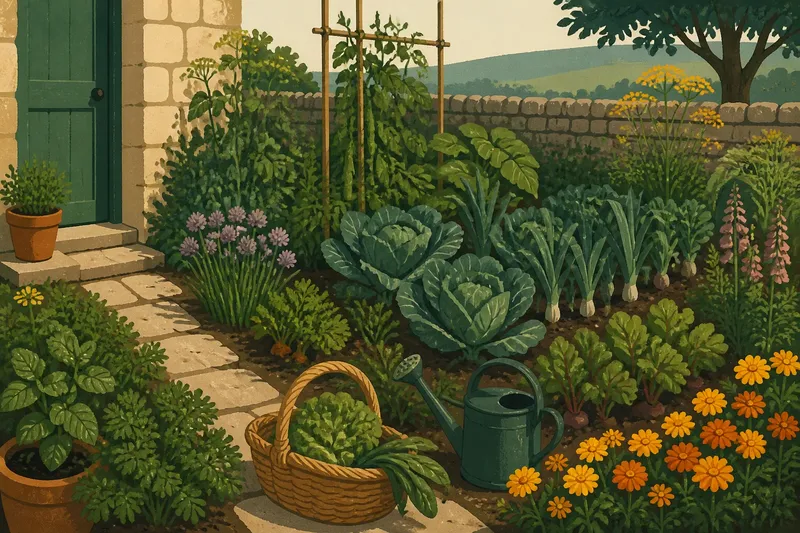
A kitchen garden before the seed catalogue was often a working patch arranged around household needs, not a miniature farm with one fixed plan. Near the back door, a cook might find parsley beside cabbages, a few flowers among the vegetables and a path clear enough for a basket or watering can.
That arrangement varied with soil, climate, custom and the space available. Its defining idea was practical closeness: crops for the pot, leaves for seasoning and flowers for colour could occupy the same small plot without being forced into separate departments.
Kitchen gardens grew from daily household routines
Before choosing what to sow, a household had to decide what the garden was for. A cook who used onions, leeks and parsley often had reason to keep them close; a family with little spare ground might favour crops that could be picked repeatedly or stored after harvest. The garden’s contents reflected meals, labour and local growing conditions.
“Kitchen garden” describes a purpose more than a universal design. Some plots sat against a house or kitchen wall; others lay beyond a yard, where the sun and soil were kinder. A cottage garden might include vegetables among flowers, while a more orderly plot might use straight beds and paths. Neither arrangement tells the whole story of rural gardening.
Household routines shaped the layout as much as appearance did. A frequently picked herb near the door was easier to snip while cooking than one at the far end of a field. A path wide enough for a basket made gathering simpler, while a sunny, sheltered corner could suit warmth-loving plants better than a shaded strip under a hedge.
Vegetables, herbs and flowers had overlapping jobs
Vegetables supplied the substantial ingredients: roots, leaves, pods and alliums. Herbs added flavour in small handfuls, and some were kept for household uses beyond seasoning. Flowers could brighten a working plot, mark an edge, fill a spare corner or provide blooms for the home. Their presence did not make a garden less useful.
The crops also occupied space differently. Tall plants could shade lower ones; climbing beans needed something to grow on; sprawling crops asked for room across the ground. Gardeners could use paths and boundaries to keep such habits manageable, but the best arrangement depended on the plants and the plot rather than on a single inherited diagram.
Flowers and herbs might also be planted where they were easy to notice and reach. A row of marigolds at a bed’s edge, for instance, offered a visible border, while mint was more convenient in a container if its spreading habit would otherwise crowd neighbouring plants. These are practical choices, not rules that every household followed.
Think of the plot like a well-used kitchen shelf: ingredients share a surface because they serve different jobs, not because every item belongs in a rigid row. The analogy has limits, since plants compete for light, water and room, but it captures the garden’s mixed purpose.
One patch could be organised in several ways
Some households divided the garden into beds with paths between them. Others grew crops in rows, used the edges for herbs or flowers, or fitted plants around a wall, fence or existing tree. A small garden might combine methods simply because its shape demanded it. The practical question was whether people could reach, tend and harvest what they had planted.
Imagine a household with a narrow sunny strip beside the kitchen and a larger patch farther away. They might place parsley and chives near the door, keep cabbages in the wider plot, and tuck flowers along the path. The expected observable result is a garden where quick kitchen pickings are close at hand while larger crops have room to develop, though the exact choices would still depend on the household’s cooking and growing conditions.
Location could change what the garden offered. A sheltered wall might extend the usefulness of a warm spot; an exposed patch might suit hardier crops better. Soil that stayed damp called for different choices from ground that dried quickly. The point is not to reconstruct one ideal historical layout, but to notice how a plan responded to its setting.
What did a household choose to grow?
Why keep herbs close to the kitchen?
Herbs used in frequent cooking were convenient near the door, where a small amount could be gathered without a longer trip. Their placement also made it easier to notice when a plant needed attention or had begun to flower.
Did every kitchen garden include flowers?
No single pattern applied to every household. Flowers might be grown for the home, included along a path or left out when space and priorities favoured food crops.
Were vegetables always planted in separate beds?
Some gardens used distinct beds, while others mixed crops with herbs or flowers. Available ground, local habits and the gardener’s preferred way of working all influenced the arrangement.
How can an old garden plan inform a modern one?
Use it as a prompt to consider access, household use and the habits of each plant, rather than as a template to copy. A present-day plot can still place regularly picked herbs near the cooking place and give spreading or tall crops suitable room.
Tradition meant adaptation, not one fixed recipe
Garden customs travelled through families and neighbourhoods, but they met local realities in each yard. Seed available to a household, the length of the growing season, the soil and the time people could spare all shaped what was planted. Even neighbours with similar plots might make different choices because they cooked differently or valued different crops.
For a new kitchen garden, begin by observing the ground and naming what the household actually uses. Notice where sunlight falls, where water collects and which route makes harvesting convenient. Then group plants by practical needs: frequently picked herbs near the kitchen, vegetables where they have room, and flowers wherever they fit the household’s purpose. Instructions on seed packets and local growing guidance can help with plant-specific choices.
The kitchen garden before the seed catalogue was not a lost master plan waiting to be recovered. It was a flexible arrangement of useful plants, shaped by the cook’s hand, the gardener’s time and the character of the ground. That is its most useful lesson now: make the plot answer to the household and place, rather than asking either to fit a picture of how a garden ought to look.